Sunday, 29 April 2018

Character Circumstances

HERO: Character Circumstances and Relationships

The 9 Questions 

1) WHO AM I?


My name is Hero, I am Leonato's daughter, Beatrice's cousin, Antonio's niece and the fianceĆ© of Claudio.  I am eighteen years old and live within Leonato's household, and have done my whole life in Messina,  Sicily.  I have known and lived with Beatrice my whole life and out of everyone in my life, she is the person I trust and value the most. I look up to her a lot and although I am aware of some of her weaker qualities, I have unconditional love for her. 
Myself and Beatrice spent our childhood in Leonato's house, and when my mum died when I was seven of lung disease, we got closer. I wasn't that close to my mother when I was younger since she was often very distant, and had been ill since I was born. She seemed quite unhappy in her relationship with my father and this took quite a toll on me as a young girl, but when she died, the grief of my whole family struck me very hard - it struck my father especially badly. Since Beatrice understood the grief of losing someone and essentially began to live with me, she became my sister rather than my cousin, despite being seven years older than me.
My earliest childhood memories I possess with Beatrice. I often had nightmares when I was little, especially when my mother died, and so I used to go into Beatrice's room and she'd comfort me and I'd fall asleep in her arms.  Myself and Beatrice's favourite place though would be the garden, and I have a vast array of memories of just playing in the garden together. I have enjoyed quite a lot of wealth my whole life, considering my father is the mayor of the town, and as a result we've had servants as long as I can remember. They used to garden and plant as we ran around the orchard. I remember when I was six, Beatrice was chasing me and I tripped over a tree stump. I felt immense pain and I remember vividly that Beatrice was just laughing in my face. She felt so guilty when she realised that the pain was real and I had broken my arm and and to make it up to me, over the next couple of months showered me with homemade presents and even picked out all the flowers in the orchard to give to me. To this, I remember my father got very angry but it did make me feel a lot better.  Myself and Beatrice haven't always got on:  when I was twelve, Beatrice and I seemingly distanced.  I once stole one of her lipsticks, one of her favourites, and she got really angry at me. We got into an argument and didn't speak for a week because both of us were too stubborn to say sorry. We naturally became friends again, as usual, as we were playing at the dinner table incidentally just a week later.  One of the best things Beatrice has ever done for me was lend me her favourite novel. My father often constrains us to the limitations of our house, and although I love his household, sometimes it can become a bit mundane. Beatrice at the time, when she was 22 and I was 15, lent me her favourite novel Wuthering Heights. I remember manicly reading it over five days and giving it back to her after that five day period. I loved it, and ever since then we've both had an avid passion for literature. Beatrice has shown me all her favourite works, including Jane Eyre, another favourite of mine, and she has got me into the habit of spending time in the library. That is when my father isn't relenting me to do mundane tasks in the garden or the kitchen.

Since my mother's death, my father, Leonato, has become more stern and hardened.  I have a difficult relationship with my father. Although I want to please and fulfil him, the principle act in doing this to be through marriage with a noble man, I still feel as though sometimes I am not truly loved by him and that I am just a reminder of his dead wife. He hasn't ever shown that much warmth to me, except a dire need for me to get married. He is overprotective of me as his only daughter, which frustrates me sometimes because I believe Beatrice has more free liberty than me.  I conform to this though because she is older, perhaps wiser and I understand that this is my rightful place within the household. Ever since I was little, my father has always stressed and anticipated the point of me getting married at the earliest possible moment, and I have come to understand that to live in a good life this is what is expected of me.   Beatrice sometimes teases me about what I would do with an 'ideal' husband. I find that she often brings out the fun side in me, so this type of teasing is common. Having said this, I love my father, and I respect him a lot and am constantly seeking to make him proud.  

I've been experiencing home tutoring since I was eight years old. I've always got good grades and done all my reading. My favourite subjects are literature and history. My tutor is quite old and stern, and is a man. He is a lot easier on me than he was on Beatrice - Beatrice was always quite naughty and would always hide rather than going to her tutor sessions. But I loved tutoring and I loved to learn. As I am 18, this is the last year that I will receive it. As well as this, my whole life I have been conditioned to follow the Christian way. I go to church with my father and Beatrice. My father is an avid Christian and I suppose I am too because I believe in God. 

People often assume I am innocent, beautiful and studious. I would say I am good, and play by the rules because I wouldn't want to upset my father.  I'm quiet because my presence often isn't needed, and when my father has meetings with noble men at the house I am not expected to speak or say my opinion.  Besides, most of the time I'm away from the crowd in the garden or reading books in the library. Sometimes Beatrice patronises me - she thinks I'm 'too pure' for this world.  I don't think I am overly innocent but I rather have a sense that everyone is inherently good and I look to see the good in people, but Beatrice sometimes counsels me and says I'm a pushover.  I think I'm quite selfless and would rather see the benefits of other people than myself. 

TEXTUAL CLUES:

What do people say about Hero / what does Hero say about herself?  

FACT / OPINION 


Hero is Leonato's only daughter. 
"I think this is your daughter" -Don Pedro, Page 3
"No child but Hero; she's his only heir" -Don Pedro, Page 7
"Marry on Hero, the daughter and heir of Leonato" -Borachio, Page 9

Hero is obliged to follow her father on who she should or shouldn't marry. This implies she is below her father and doesn't have free liberty, which is accepted by everyone in the play.
"Well, niece, I trust you will be ruled by your father" -Antonio, P10
"Daughter, remember what I told you: if the prince do solicit you in that kind, you know your answer" -Leonato, P11
"It is my cousin's duty to make curtsy and say 'Father, as it please you'" - Beatrice, P10

Claudio plans to marry Hero when Don Pedro sets them up together (this is unbeknown to Hero's knowledge)
"And tell fair Hero I am Claudio, and in her bosom I'll unclasp my heart. Then after to her father will I break, and the conclusion is, she shall be thine" -Don Pedro, P18
"It is so, the count Claudio shall marry the daughter of Leonato" -Don John, P18

Claudio believes that Hero is modest. 
"Is she not a modest young lady?'" -Claudio, Page 5

Hero believes that Don John has a melancholy disposition, quite a nice thing to say in comparison to what everyone else is saying about him.
"He is of a very melancholy disposition" -Hero, p10

Benedick doesn't find Hero attractive.
"Methinks she's too low for a high praise, too brown for a fair praise, and too little for a great praise / she were unhandsome"  -Benedick, Page 5

Claudio believes that Hero is the most beautiful woman he has ever seen. 
"Can the world buy such a jewel?"  -P5
"In mine eye, she is the sweetest lady that ever I looked on" -P5

Don Pedro believes that Hero is worthy of Claudio's love.
"Amen, if you love her, for the lady is very well worthy" -Don Pedro, P6
"Fair Hero" -Don Pedro, P7

Claudio looked on Hero before he went to war.
"I look'd upon her with a soldier's eye"
"All prompting how fair young Hero is, saying I liked her ere I went to wars" -P7

Claudio loves Hero.
"That I love her, I feel" -Claudio, P6

Don John believes Hero is lively and young.
"A very forward March-Chick" -Don John, P9

Don John tricks Claudio into believing that Don Pedro has wooed Hero. 
"My brother is amourous on Hero"
"He is enamoured on Hero" -Don John, P13

Hero jokes with Don Pedro at the masked ball, and is open towards being wooed by Don Pedro/Claudio. 
"So you walk softly and look sweetly and say nothing, I am yours for the walk. And especially when I walk away"  -Hero, p11

Claudio feels a sense of ownership over Hero, and commitment towards her.
"Lady, as you are mine, I am yours: I give away myself for you and dote upon the exchange" -Claudio, P16

Hero feels as though she has a duty to unite Beatrice and Benedick and she cares about her cousin's happiness. 
"I will do any modest office, my lord, to help my cousin to a good husband" -Hero, P17
"My talk to thee must be how Benedick is sick in love with Beatrice" -Hero, P24
"And here's another writ in my cousin's hand, stolen from her pocket, containing her affection unto Benedick" -Hero, p55

Hero cleverly plots how to execute Don Pedro's plan, and instructs Ursula and Margaret to help her.
"Bid her steal into the pleached bower, there she will hide her, to listen our purpose.
Our talk must be only be of Benedick. When I do name him, let it be thy part to praise him more than ever man did merit" -p24

Hero criticises Beatrice for being 'too proud'
"Disdain and scorn ride sparkling in her eyes, misprising what they look on, and her wit values itself so highly that to her, all matter else seems weak. She cannot love, nor take no shape, or project of affection. She is so self endeared" -Hero, p25

Hero has a good familiarity of Leonato's garden.
"Bid her steal into the pleached bower" -p24

Don John tricks Claudio and Don Pedro into believing that Hero is unfaithful.
"The lady is disloyal" -Don John, P28

Don John insinuates every man's ownership of Hero, and her low status as a woman to accentuate her unfaithfulness.
"Leonato's Hero; your Hero, every man's Hero" -Don John, p28

Claudio is determined to shame Hero on their wedding day, believing she is unfaithful.
"There will I shame her" -Claudio, p28

Hero can't wait to marry Claudio.
"Why, everyday, tomorrow" -Hero, p26
"My heart is exceeding heavy" -Hero, p32

Hero feels offended by Margaret and is determined to wear what she wants.
"My cousin's a fool, and thou art another. I'll wear none but this." -Hero, p32
"Fie upon thee! Art not ashamed?" -Hero, p32

Hero notices Beatrice is ill.
"Why how now? Do you speak in the sick tune?" -Hero, p32

Claudio shames Hero as an unfaithful 'whore', accusing her of sleeping with Borachio. 
"She's but the sign and semblance of her honour. She knows the heat of a luxurious bed. Her blush is guiltiness, not modesty" -Claudio, p35/p36
"Not to knit my soul with an approved wanton" -Claudio, p36
"You are more intemperate in your blood than Venus, or those pamper'd animals that rage in savage sensuality" -Claudio, p36

Don Pedro also denounces Hero as a whore.
"A common stale" -Don Pedro, p36
"You are no maiden"

Leonato is ashamed of Hero.
"Death is the fairest cover of her shame that may be wish'd for" -Leonato, p37
"Thou seest that all the grace she hath left is that she will not add to her damnation a sin of perjury, she not denies it!" -Leonato, p38

Friar Francis and Beatrice are adamant of Hero's innocence.
"If this sweet lady lie not guiltless here under some biting error" -Friar Francis, p38
"O, on my soul, my cousin is belied" -Beatrice, p38
"Sweet Hero! She is wronged, she is slandered, she is undone" -Beatrice, p41

Benedick also believes Hero is innocent.
"I do believe your fair cousin is wronged" -Benedick, p40
"You have killed a sweet lady, and her death shall fall heavy on you" -Benedick, p46
"You have among you killed a sweet and innocent lady" -Benedick, p47

Hero knows she is innocent.
"They know that do accuse me; I know none" -Hero, p39

Leonato eventually realises Hero is innocent. 
"Thou hast so wrong'd mine innocent child and me" -Leonato, p45

Hero fakes her death following the wedding.
"Your daughter here the princes left for dead, Let her awhile be secretly kept in, and publish it that she is dead indeed" -Friar Francis, p39

Don Pedro feels sorry for Hero's 'death' but believes shaming her was the right thing to do. 
"My heart is sorry for your daughter's death. But, on my honour, she was charged with nothing but what was true and very full of proof" -Don Pedro, p45

Claudio realises of his love for Hero once he realises she's guilty.
"Sweet Hero! Now thy image doth appear in the rare semblance that I loved it first" -Claudio, p48

Hero sees Claudio as her soulmate regardless of what happened.
"And when I lived, I was your other wife. And when you loved, you were my other husband" -Hero, p54

Hero proclaims herself to go ahead as an innocent virgin.
"One Hero died defiled, but I do live, and surely as I live, I am a maid" -Hero, p54

MY RELATIONSHIP WITH CLAUDIO 
(I worked on this back story with Sean) 


A few weeks before the war, Claudio was staying at Leonato's house with Benedick and Don Pedro as a number of ceremonies and meetings were taking place for arrangements. Claudio noticed Hero as they began to bump into eachother, or see eachother around the house countless times. Hero and Claudio were instantly attracted to eachother, but Hero felt subordinate and not worthy of Claudio considering that her status was a lot lower. Nonetheless, Hero found Claudio as a mysterious soldier very attractive. Eventually, they started talking to eachother in the corridor after Claudio iniated conversation and realised who Hero was as Leonato's daughter.  They made links and got on very well, and Claudio asked Hero a lot of questions about herself and flirted with her a lot. Hero was very flattered but saw it as a one time occurance as she was used to a lot of men who visited the house being quite friendly and flirty. Hero complained to Claudio that her father was making her work in the garden the following day to unpick weeds and do gardening, which Claudio found amusing as he enjoyed her wit and complaints. Claudio assured Hero as a joke that if he didn't have military training at that time then he would keep her company, and wished her well.  The next day, when Hero was in the garden, she noticed Claudio lingering around, clearly trying to catch her attention. He'd skived off military training to see her, and she was flattered. They spoke for hours on a bench next to the cherry tree, about everything and anything until Hero had to go back inside for dinner. They joked about seeing eachother in the same place the next night, but it actually occured, and for every night of the remainder of the time Claudio and Hero met in the same place to talk. It was a secret and intimate place. One night, Claudio asked Hero to dance with him in the garden, which cemented her attraction towards him. Their growing intimacy in such a short time led them both to be infatuated with eachother and Hero was very much in denial that Claudio would have to go to war soon, until the night before he left where he promised her he would see her again. Over the next seven months, Hero carried on with her life, but was impatient to see Claudio again, and when she finally did, she was ecstatic with joy. Their relationship from before the war to when Claudio returned was very much built on the foundation of lust, but after Hero's rejection by Claudio and all of the orchestrated ordeals that occur, Hero and Claudio mature and realise that in fact they do love eachother. Hero matures a lot from the situation with Claudio as she realises her place within society and begins to become more self confident. 


2) WHERE AM I?

During most of the play, I am in Leonato's household, in the garden or in the hall. These are settings in which I am overwhelmingly familiar, and so I am mostly comfortable in those surroundings.  My favourite setting is the garden, where I spend a lot of independent time, and that is why I seek to trick Beatrice there, because I have a good understanding of the locations.  Nevertheless, I have an astute awareness of who I am around in these settings, all of which generally have a higher status than me, especially Don Pedro, who I find quite intimidating because of the overwhelming power he has over me.The climate in Sicily is generally quite humid, so I am usually wearing airy clothing of light colours.  The setting I live in is most exciting at the time of the play because the war has just ended and the town is alive with celebration and excitement. 

^Messina in 19th Century


3) WHEN IS IT?

It is spring, set in the modern timeless era before the 1950s.


4) WHAT DO I WANT?

Hero's super objective is stability throughout the play to maintain her social position. Because she's a woman and is more towards the bottom of the social structure, she has to maintain stability through pleasing other people, particularly her father who enforces the social structures through his pressure on her to marry a good husband.

5) WHY DO I WANT IT?

Hero wants stability because she has enjoyed privilege all her life, and because she isn't that respected by the men around her, she asserts that the best way to be happy is to be stable, whether that is marrying someone she hardly knows to please her father or to pretend she is dead. 

6) WHY DO I WANT IT NOW? 

Hero is eighteen and at the age where she is expected to marry to a good husband and move away from the family home. She feels she is mature enough to make this progression.
She has also seen that Beatrice, her elder cousin who has not married yet has subtly offended her father, and has learnt from Beatrice's example of how to please her father.

7) WHAT HAPPENS IF I DON'T GET IT NOW? 

Marriage is viewed by those around Hero as extremely important and vital for the stability as a woman. It is expected of her at eighteen to already be paired with a man. If she doesn't maintain stability through this way she will be shamed upon from society, at risk of social ostracisation particularly as a high status woman with more pressure to fulfil social norms. The main source of this pressure comes from her father, and she feels if she doesn't follow his command then she will be ostracised from the family and sent to a convent, something which happens to a lot of girls in her class and at her age. 

8) HOW WILL I GET WHAT I WANT BY DOING WHAT?

In the long term, I will ensure that I am continually aware of my position within the social strata and never subvert from this. I will obey my father and my uncle, and I will accept the hierarchy that I exist in, meaning I have to pay respect to those higher than me.
I will seek a husband, Claudio, and attempt to please my father constantly.

9) WHAT MUST I OVERCOME? 

Primarily, I have to overcome Beatrice's example. Beatrice is my cousin and my best friend and she somewhat rebels against the social expectations of women our age. She is a lot more witty than I am and brings the fun out of me, but sometimes to an extent where it displeases my father, and makes me easily influenced and as a result, more rebellious under her example.
But more significantly, I have to overcome the harsh intentions of others who have contrasting motivations to me. I seek to see the good in everyone continually but sometimes this means I can be naive and therefore I am wronged by people when I least expect it. I have to overcome this to ensure I can reach my objective of stability. 

Saturday, 21 April 2018

Historical Context

What was life like in Elizabethan England?
REFERENCE: http://www.bbc.co.uk/programmes/b036lgmn/clips - BBC Time Traveller's Guide to Elizabethan England  and further research: http://www.elizabethan-era.org.uk/

When Elizabeth I became queen in 1558, there were about 2.8 million people in England. During her reign, the population grew significantly to about 4.1 million people. While many people lived in the countryside, a lot of people resided in or migrated to London, which was the richest and most rapidly growing city of the time, housing royalty and wealth. It was a more attractive place to live.  Besides, life in the rural countryside was not pleasant in comparison to the blossoming prosperous cities.  In the countryside, peasants resided in small, dark thatched cottages where 7 or 8 people were cramped inside. There was no colour or light, and it usually consisted of one room with an earth floor, a permanently lit fire and as a result, smoke filling the whole room. To prevent suffocation, a hole was put in the roof. The windows were singularly glazed and only shutters were used, and this let in the cold. Candlelight was the obvious answer in the Elizabeth era, and although their menial expense today, at the time they were relatively dear and as a result the poor peasantry couldn't afford to light their menial homes. Furthermore, peasants wouldn't necessarily have a lot of possessions except necessities, sleeping on the floor or thin, straw mattresses. A text called 'The City of Norwich, Orders for The Poor' written in 1571 brands the experience of the peasantry in these cottages: "The cold struck so deep in them, their flesh was eaten with vermin and corrupt diseases grew on them". It was no wonder that they wanted to migrate to London. 

Moreover, life for the poor in rural areas was particularly difficult because class disparity was so prevalent. There was a lack of social mobility for these classes and Elizabethan society was strictly divided into the class that you were born in. For example, most countrymen at the time fell into one of three classes; the yeoman, who owns or rents farm and employs workers, a Husbandman who rents the land he works on  and labourers, who work on the farms - most peasants worked in this field.  There was also the Monarch, the highest class, the nobility, the gentry, the merchant, yeoman and finally the labourers, the lowest class. Working days were hard for labourers and involved drudgery, with long monotonous hours from the crack of dawn to sunset. 'The Groat' was a thin coin roughly the same size as a modern 20p, and was part of society since Medieval times. It was also referred to as fourpence, and was given as a sum to labourers at the time. A labourer typically earned fourpence a day.  Although this could get labouring families just by with enough food, it left nothing for firewood, clothing, child care or rent. As a result, these wages were futile for struggling families. Ordinary customs like getting married and having children weren't easily accessible for the poor as a result, and this emphasises the strict and hostile class divisions that were in place in the Elizabethan era. 

In stark contrast,  Elizabethan London was a hustling and bustling centre of international trade, government, the gentry and royalty, with opportunities to make money and prosper.  In particular, the city's population increased from 70,000 to 200,000 under Queen Elizabeth's reign because as mentioned before, the city was affected continuously by heavy migration. There were many numerous attractions, such as The Tower of London, where you could see exotic animals or tourguides as a tourist. But tourism costed 12 weeks wages for the average labourer - this emphasises the extravagance of London as a city, and how expensive it was even just to visit there. London Bridge again was the home of wealthy merchants, shops and public toilets, substantiated by heavy fortifications.  In 1599, the Swiss tourist Thomas Platter remarked that "London is not in England, but England is in London". This undoubtedly echoes the sentiment around overcrowding in London at this time, which despite its wealth, was a poignant issue for increasing population.  Queen Elizabeth  particularly abhorred expansion and stated that no new building could occur outside the city walls. Subsequently, houses were cramped and closely packed tog ether, and because of the lack of space, house prices accelerated in price. There was high unemployment due to mass migration. Nevertheless, popular jobs did include; a bottler, who stored and dispensed wines, a chaplain, responsible for the religious activities of a castle servant, apothecary which gave remedies/drugs, a cordwainer/shoemaker/cobbler or a spinster, exclusively for women where she earned her living spinning yarn. Moreover,  sanitary was awful, sewage could be smelt everywhere and there was bad tensions, particularly surrounding the stigma around the threat of The Plague, which killed 170,000 people in 1563. Outbreaks occurred across England, and the epitome of The Plague was unfortunately in London, where rats, mice and fleas roamed free.  Poorer areas, like slums, were most badly affected. Unfortunately, medicine at this time wasn't advanced and theories surrounding The Plague only assumed supposed cures that in reality did no good. What's more, physicians wouldn't even go near victims of The Plague which only accelerated the way in which the disease spread, killing a  third of the population. Instead, victims were quarantined for a minimum of 6 weeks. No matter how rich or ambitious, the Plague was the only common ground that the richer classes sought with the poorer ones as they were equally susceptible, both actually having bad living conditions and bad knowledge of diet. 

Elizabethan medicine around this time consisted of basic medicine. Physicians were unqualified most of the time, basing their hypothesis on ancient teachings of Aristotle and Hippocrates. In particular, physicians were interested in a patients bodily fluids, called Humours, which explained why patients were subjected to 'bleeding'. Other Elizabethan physicians commonly believed in astrology to base their hypothesis. The Elizabethan medical profession could only offer a herb concoction or an offer to bled the patient of The Plague. Furthermore, your class often dictated what sort of physician you would gain - only the most wealthy could receive the advice of an Elizabethian physician trained in a  university, as this cost a gold coin worth 10 shillings.  Because this was quite unaccessible, many people indulged in Elizabethan apothecary, which dispensed drugs. There was a local 'wise woman' who was often the first person contacted by poor people. Other terrible diseases like the Bubonic Plague consisted of Typhoid, Syphilis, Anaemia, Rheumatism, Arthritis, Tuberculosis and Dysentry.  Upper classes also suffered from gout and influenza was, too, common referred to as 'the sweating sickness'. Moreover, broken bones, wounds, abscesses and fractures were treated in unsanitary environments making the condition worse. In cases where amputations were needed, they were performed by surgeons. 

The landed gentry can be regarded as the richest and most powerful people in Elizabethan England. They are the middle class, who control the people around them, owning and running the whole country. From the ranks of the gentry, the magistrates, sheriffs, officials  and other positions in Parliament reside, filling the House of Commons. While they had a lot at their disposal, comfortably well off, they also were under increasing suspicion by Queen Elizabeth I, who was paranoid and wanted absolute loyalty from her subjects. Treason and assassination was seen as the highest possible crime in the Elizabethan era, which is prevalent in Shakespeare's Macbeth and almost is a commentary on the stigma behind this crime, and the Queen had an extensive spy network designed to uncover her opposition and enemies.  For example, Mary Queen of Scots was executed due to this. The rich and powerful could also definitely indulge in culture, such as art or entertainment. Because the lives of the Elizabethans were hard, with the high mortality rate (infant mortality was particularly high, shown in Shakespeare's plays like Macbeth, Romeo and Juliet and Much Ado), disease and low life expectancy, Elizabethan entertainment was at the forefront for all. Going to the theatre was the most popular activity for the masses, simply because it was so accessible for all classes. There were many days devoted to feasting, such as Mad Day, Midsummer Day and Ascension Day when people would drink and make merry. Dance was exceedingly popular and games like chess, checkers and tennis were popular. In The Tempest, Miranda plays chess to reflect this common obsession in Elizabethan society. The upper classes engage  in tournaments of fencing and hunting for sport. All classes, however, also seemed to gain pleasure from bear baiting, which was Queen Elizabeth's favourite pastime to the extent where the theatre was banned on Thursdays.  In Shakespeare's 'Macbeth', he alludes to bear baiting - "But bear like, I must fight the course". Moreover, drinking beer and ale was considered a good pastime.  Otherwise, Elizabethan's are known for travelling a lot, irrespective of wealth. In the 1570s, a secondhand coach cost around £80, with horses as an additional £10.  

Something embodied in Elizabethan culture was religion. The two major religions at this time were Catholicism and Protestant religions. The convictions and beliefs in these religions were so strong that they led to the executions of those who dissented from general belief. The reigning monarchs dictated the favouring religion - Queen Elizabeth adhered to the Protestant religion, therefore this was taught in schools nationally. Nevertheless, she did believe that people could practice the Catholic religion if it wasn't detrimental to her rule. Having said this, there were many Catholic plots versus Queen Elizabeth I, such as the attempt to replace the Queen with her cousin, Mary Queen of Scots, which led to her execution. There was laws that fined those who didn't attend church, and this kept the Church of England firmly in place. Some Elizabethans believed the Protestant reformation, some where staunchly Catholic, some were ambivalent and others practiced Puritanism which was a stricter form of Christianity. As a result, Shakespeare often referenced religion and its effects on culture and politics in his plays - the character of Malvolio in Twelfth Night satirises the strict Puritan lifestyle, for example. While Shakespeare's audiences would have been familiar with the Bible and Christianity, Shakespeare had to remain neutral with his own religious beliefs therefore they are not know. His plays do give a clear insight into the religious climate in Elizabethan England however. 

Superstition was also very commonplace in Elizabethan society. Most superstition arose due to the fear of witchcraft, where most women were accused of being witches. There were 270 Elizabethan witch trials where 247 were women and 23 were men. With the fear around the Bubonic Plague and unexplained disease, and no medicinal knowledge, many blamed witches. Similarly, failed crop harvests, the death of animals and unexplained fires were also scapegoated to witches.  Mostly, the women accused were old, poor, unprotected single women or 'widows'. Many believed that witches could fly, a witch was an old hag, lived alone, known to keep animals like cats or frogs, and brewed magic potions over a cauldron. Some more Elizabethan superstitions, some of which are still known today led to; people saying 'God Bless You' after a sneeze, as Elizabethans believed that the devil could enter your body if not, an eclipse being seen as an omen of evil, unlucky for a black cat to cross your path, unlucky to keep the feather of a peacock, touch wood to guard against bad luck, bad luck to walk under ladders, and bad luck to put shoes on a table. 

 Perhaps women being regarded as witches was a product of the largely engrained patriarchal Elizabethan society. The roles of women were limited, and of course men were breadwinners. On average, a woman gave birth to a child every two years, and this was seen as a blessing from God and something to be proud of. Having said this, infant mortality was very high.  As well as this, women weren't able to enter professions like law, medicine or politics but they could work in domestic services as cooks or maids.  Prominently, acting was seen as certainly dishonourable for women to engage in and it wasn't till the seventeenth century that women appeared on the stage. Despite these limitations, The Renaissance brought a slightly new way of thinking - noble middle class women were given an impressive education in the classics, mathematics and other academia. Elizabeth being on the throne encouraged noble men to educate their daughters. The women that suffered most in this period consisted of those who didn't wish to marry, even though the Queen herself was unmarried. Marriage was seen as the most desirable state for both men and women, and single women, as mentioned previously, were accused to be witches. Following The Reformation, women couldn't easily become nuns and live in convents, because convents were closed - the only feasible career option for poor women was to work in domestic service. As a result, the pressure around marriage was immense. 

Elizabethan Era Context Notes 

Who was William Shakespeare?


  • Shakespeare is the world's most famous playwright, considered the greatest dramatist of all time and England's national poet. Despite his great array of 37 plays and a vast amount of sonnets, his personal life is shrouded in mystery.
  • William Shakespeare was born in 1564 in Stratford Upon Avon, a market town in the Midlands. Only 1,000 people lived there. 
  • Shakespeare was born to prosperous parents as the third child of John Shakespeare, a leather merchant and Mary Arden who was a local landed heiress. Before Shakespeare's birth, records indicate that his father held official positions such as alderman and bailiff, an office resembling a mayor, despite this, it is believed that John's fortunes decline sometime in the late 1570s.
  • However, in spite of his somewhat wealthy background, his life involving family wasn't easy. He was the third of eight children and grew up the oldest, his two older sisters dying very young. In fact, Shakespeare was lucky not to be a victim of the plague which was widespread during his lifetime, killing 1 in 5 of the population in Stratford.
  •  From the age of seven, boys like William attended grammar school - scholars surmise that he most likely attended the King's New School in Stratford which taught reading, writing, Latin and the  classics.   They also had to memorise and perform historical stories, useful skills for an actor and writer. Shakespeare probably left school aged fifteen. 
  • On November 28th, 1582, William Shakespeare married Anne Hathaway in Worcester, Canterbury. They gave birth to the first child, a daughter called Susanna on May 26th, 1583 while two years later they gave birth to two twins. One of them later died at age 11. 
  • After 1585, there are seven years where no records exist after the births of his twins. Scholars brand these years the 'lost years' and there is wide speculation on what he was doing during this period - his life was quite a mystery.
  • From 1590 to 1613, Shakespeare lived mainly in London and had become a managing partner in the Lord Chamberlain's Men, an acting company which he connected for most of his career. Considered the most important troupe of its time, the company changed its name to the King\s Men following the crowning of King James I, in 1603.
  • He also established himself as a playwright, with his play Henry VI performed at the Rose Theatre in 1592. Over the course of two decades, he wrote a total of 37 plays which revolved around histories, tragedies, comedies and tragicomedies.  Most of his early plays were histories (Henry VI, Richard II, Henry V)  and comedies (A Midsummer Night's Dream, Merchant of Venice, Much Ado About Nothing, As You Like It) but in the later period he diverted more so towards writing tragic plays (Hamlet, Othello, King Lear and Macbeth). These tragedies presented vivid impressions of human temperament, exposing human nature.  In his final period, he wrote several tragicomedies (Cymbeline, The Winter's Tale and The Tempest) embodying somewhat of a graver tone than the comedies but ending in reconciliation. 
  • Shakespeare's early plays were written in the conventional style of the day, with metaphors and rhetoric. Nevertheless, Shakespeare was innovative and adapted the traditional conventional style to his own purposes and creating a freer flow of words. He primarily used a metrical pattern of iambic pentameter or blank verse to compose plays, but he also used poetry and simple prose.
  •  From 1599, he was part owner of The Globe Theatre where his plays were performed. In 1605, Shakespeare purchased leases of real estate near Stratford for 440 pounds, which doubled in value and earned him 60 pounds a year. He became a businessman as well as an artist, and it is believed this gave him precedence to keep on his job as a freelance writer despite the reputation around playwrights.
After 1613, Shakespeare spent more time in Stratford. In January 1616, he made a will and died on the 23rd of April 1616. He was buried in Holy Trinity Church in Stratford Upon Avon.        

London At The Time of Shakespeare's Work

  • London was the bigger and richer city in England. It was the home of most permanent playhouses. Wealthy traders, businessmen and manufacturers resided there. They had the money to go to the theatre, or to put in leases for playhouses to be built.
  • By 1600, London's theatre goers numbered 20,000 per week. 
  • London was also home to royalty and nobility, where rich noblemen became patrons of theatre companies, giving financial/legal support.
  • From 1603-1613, Shakespeare's company played at the court of King James about 15 times a year. 
  • London was a rapidly growing city with many migrants from across Europe and the country. 
  • Between 1550 and 1600, it is estimated the city grew from around 50,000 residents to over 200,000. Despite this, it was relatively overcrowded. The pollution was bad, and te dark conditions attracted thieves and brought disease, such as the plague. The Plague struck most summers, in 1593 about 10,000 people were killed and all the theatres were closed.  
  • The city's landmarks include St Pauls Cathedral was the biggest of London's 120 churches. Crowds gathered here to socialise or do business - this attracted pickpockets and prostitution. Outside the cathedral, there was a market and it was London's centre for bookselling. The Tower of London was London's old medieval fortress. By 1600 it housed rooms for the royal family, a treasury, a prison, a weapons store, a zoo and the royal mint, where nearly all England's coins were made. London Bridge at the time was the only bridge in London. It joined the city of London, on the north bank of the Thames with Southwark on the south bank (this is where The Globe Theatre was). 
  • Shakespeare lived and worked in London from about 1590 to about 1613. It is believed he lived in the London parish of St Helens in the mid 1590s. This was north of London Bridge and close to The Theatre and The Curtain playhouses. He was twice assessed for taxes there and failed to pay both times. 
  • From about 1598-1602, Shakespeare lived in the Paris Gardens area of Bankside south of the river near the Globe, where he worked.
  • From 1602, Shakespeare rented lodgings in the Silver Street house of the Mountjoys, a family of French immigrants who made extravagant costly hats.                                                              
What Was The Theatrical Landscape Like In Shakespeare's Time?

Writing Plays
  • A modern historian estimates that between 1560 and 1640, some 3000 new plays were written and performed in London. 
  • William Shakespeare was become the most famous playwright in the world originating from this time, but the best known of other famous playwrights are Ben Jonson, Christopher Marlowe, Francis Beaumont, John Fletcher, Thomas Middleton and Thomas Kyd.
  • The grammar schools that most middle class boys attended taught useful skills for playwrights of the time as they were taught to memorise the history and myths of Ancient Greece and Rome - they wrote their own stories and recited these to classmates. Many playwrights also went to university,  like Marlowe, but some playwrights also went straight into acting, like Shakespeare and Jonson. 
  • Originality was not at the forefront for playwrights of this era - the norm was to rework and invigorate old stories/use other people's plots. Shakespeare's 'The Taming of The Shrew', for example is a re-write of an earlier play, whereas 'The Comedy of Errors' is based on an ancient Roman plot. 
  • Plays were divided into three categories - histories, tragedies and comedies. 
  • Histories told of England's past. Marlowe wrote Edward II, while Shakespeare wrote plays about King John, Henry IV, Henry V, Henry VI, Richard III and Henry VIII. 
  • Tragedies usually ended in deaths, for example Romeo and Juliet, Othello and Hamlet written by Shakespeare, while John Webster had a big hit with The Duchess of Malfi. Blood and gore were integrated by the playwrights to entertain the crowds.
  • Comedies were generally lighthearted and had a 'happy ending', usually a wedding.  Some comedies were satirical. Ben Jonson wrote The Alchemist which satirised London society.
  • Playwrights weren't generally wealthy - they got no royalties or repeat fees if plays were performed more than once, but instead generally a one off fee for selling their play to an acting company. Others had to share the money because it was common for playwrights to write in paies on in groups. 
  • Philip Henslowe was a theatre owner who hired four writers called Chettle, Wilson, Dekker and Drayton. He paid them in instalments and they often worked on multiple projects simultaneously at his disposal. The fee for a play was worth having, in the 1590s it was £5 which equated to a year's income for an average craftsman or shopkeeper at that time. 
  • Censorship was prevalent. The Master Of The Revels was a genuine job, an official of the royal court who had to grant licenses to theatres, companies and plays. He would not license a play if it had subversive political or religious views. Playwrights therefore, had to tailor their plays carefully so they weren't too offensive and weren't at risk of censorship. As a result, playwrights commonly set their plays in imaginary or distant countries to avoid risk of seeming critical of the home government.
Actors

  • During Shakespeare's lifetime, the life of an actor changed dramatically. Actors primarily toured in companies nationally, but by the end of Shakespeare's lifetime, London had several permanent theatres, drawing in middle class theatre goers. 
  • The acting profession had a bad reputation and actors were seen as a threat to peaceful society.
  • In Shakespeare's time, only boys and men could act, until 1600 when women were allowed to act in public theatres. Therefore, in an Elizabethan production men would play female parts.
  • Generally, actors started their careers as young boys, gaining apprenticeships and then gaining greater positions as senior actors within the company. They had to be able to sword fight, sing and dance.
  • Company sizes varied, depending on region and wealth. A wealthy company when working in a theatre could have 8-12 senior members called sharers, 3-4 boys, a number of hired players and then stage hands, tiremen and some musicians. Actors would join a company under the patronage of a monarch, like The Queen's Men or a noblemen such as The Lord Chamberlain's Men.
  • Most companies were based in London using permanent theatres. When plague was prevalent, the theatres would close and companies would tour. Mostly they toured England but some exclusive companies travelled abroad, like to The Netherlands or Germany.
  • Many actor companies held a shareholder system where sharers in a company earned more than the hired men. Shakespeare, for example, was a sharer of The Chamberlain's Men, and so shared the profit the company would make. Generally, actors earnings were also dependent on where the company was playing. The company made more money in London than in the country so actors wages were higher. 
  • Actors normally performed in the afternoon because they only relied on natural light. Plays were performed in repetory therefore the same play was never performed two days in a row. Actors would spend mornings rehearsing and then the afternoon performing. Often they were juggling several plays and characters at a time.
  • Actors learnt their parts by having their own part written out to learn, because there wasn't multiple copies of the play. An actor's part only contained their cues and lines. 
  • Some famous Elizabethan actors include Richard Burbage, Edward Alleyn and Robert Armin. 
  • Often, playwrights wrote plays for specific actors, for example Dogberry was written for William Kemp who was good at physical comedy, whereas the fool in King Lear was written for Robert Armin who was good at witty comedy as opposed to slapstick.

Playhouses

  • There were two types of playhouses in Shakespeare's time: the outdoor amphitheatres (public playhouses) and the indoor playhouse (halls or private playhouses). These attracted different types of audiences.
  • The first playhouse, The Red Lion was built in 1567 by John Brayne. He converted The Red Lion Inn in Stepney, outside the city walls.  
  • More playhouses opened between the 1570s and the 1620s following this, including the second playhouse to be built in 1576 called The Theatre, built by Brayne and James Burbage. Burbage was an actor with the Earl of Leicester's Men, who played in The Theatre for its first two years.
  • Newington Butts theatre was built in the south in the same year, and in 1577 the Curtain was built near the Theatre. After this, five more theatres were built and companies also performed regularly in the yards of several London inns. 
  • Playhouses drew big audiences but weren't popular with everyone. The officials who ran the City of London saw playhouses as raucous and disruptive, attracting thieves and other 'undesirable' people. People subsequently built playhouses on sites outside the control of citty officials, generally outside the city wall.
  • The south bank of the River Thames was outside the city and had animal baiting arenas, brothels and taverns where people could buy food and drink, so people already went there for entertainment. 
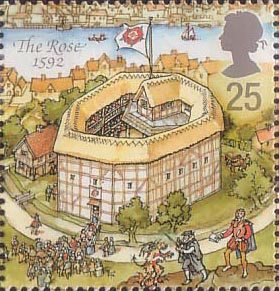
  • Outdoor playhouses had an open yard open to the sky, a raised stage sticking out into the yard, a roof over the stage known as 'the heavens', a tiring house with a backstage area where actors dressed and galleried seating all around the yard.
  • Playhouses were often built by businessmen seeking profit who saw the prospects of rising interest and therefore prosperity to be found in touring acting companies who played in yards and open spaces around the country. They had money to spare, in contrast to the acting companies therefore a businessman would lease some land, build a playhouse and lease it to acting companies for a set number of years. The company paid the playhouse owner a share of the takings, usually half of the income from galleries. 
  • Playhouses had a brick base with timber framed walls. The gaps between the timber were filled with sticks, hair and plaster. The roofs were made from thatch or tile. 
The Globe Theatre

  • Many of Shakespeare's first plays were performed at The Globe, although his plays were performed at other theatres and many playwrights wrote for The Globe. 
  • Initially, the first Globe was built by The Lord Chamberlain's Men which Shakespeare was a part of. Richard Burbage was the company's leading actor. They had played at the Theatre built by the Burbage family, but when this fell through, they leased new land on the south bank of the River Thames, near the Rose Theatre.
  • The builder who stored the timbers of the Theatre was Peter Streete. Once the weather was better, Streete took the timber across the thames, to Southwark and used them to build the Globe Theatre.
  • Southwark was a convenient place for the new theatre, outside the control of hostile city officials. 
  • Streete and his workmen built a brick base for the theatre. The walls were made from timber frames, filled with smaller slats of wood covered with plaster that had cow hair in it. Because the owners were struggling for money, they used the cheapest options in the building process, therefore the roof was thatched with reeds and not covered with better quality tile. 
  • In 1599, the theatre opened and was a huge success. The first Shakespeare play to be perfored was Julius Caesar in the same year. Other playwrights that wrote for the Globe include Ben Jonson, Thomas Dekker and John Fletcher. 
  • On the 29th June 1613, The Globe burnt down due to a fire caused by a performance of Henry VIII where small cannons were fired. They used gunpowder held down by wadding, but as a result a piece of burning wadding set fire to the thatch. In an hour, the theatre burnt down and was huge news. 
  • The company built a second Globe on the brick foundations of the first. It was the same size and shape, but was more extravagantly decorated. The company could now afford to use a tiled roof.

Indoor Theatres 

  • Indoor theatres grew out of temporary theatres in existing buildings set up for private performances, but they were open to the public and charged an entry fee. The first permanent indoor theatre (St Pauls) was built in 1575.
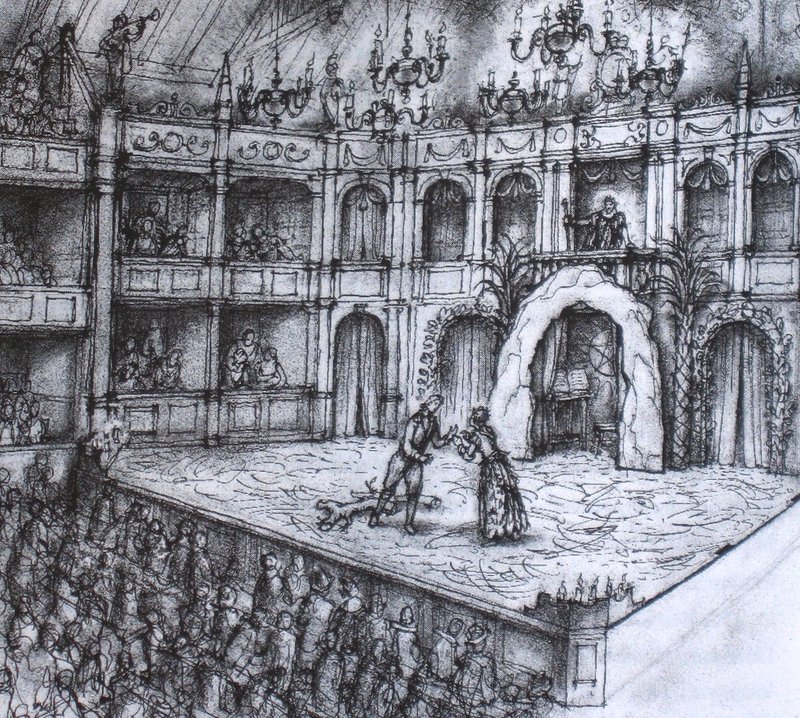
  • Indoor theatres were different to outdoor playhouses through; being smaller, holding a more intimate audience, built inside an existing building, not open to the sky, more expensive compared to open yard standing and lit by candles/ daylight through windows.
  • Until 1609, the indoor theatres were used by boy companies. Adult companies played at the outdoor playhouses. The boy companies grew out of choir schools and other schools that performed privately. They were made up of boys of any age between seven and their early twenties. They usually played once a week. 
  • The audiences in these theatres were thought to more educated and wealthy as opposed to audiences in outdoor theatres. Scholars used to think that indoor theatres held more music, more intricate props and more speeches as opposed to action. Plays written for the boy companies, such as Cynthia's Revels by Ben Jonson certainly did. When The King's Men, Shakespeare's adult company used both The Globe and the Blackfriars, they played some popular plays in both theatres.
  • Whether a play would be put on inside an indoor theatre or outdoor theatre was generally practically reasoned. Indoor theatres had a smaller stage, and generally stools could be put on the stage were rich 'gallants' sat to be seen. Actors therefore had far less space to act, on the other hand the smaller, intimate space enhanced a play's magical effects.  Shakespeare wrote The Tempest with The Blackfriars theatre in mind, as well as A Winter's Tale and Cymbeline. 
  • The candles meant that there had to be small intervals for people to trim the candles and replace the burnt out ones. 
Audiences

  • Between 10,000 and 20,000 people visited London theatres a week. 
  • Theatres were extremely popular, one visitor in 1617 described the crowd around the stage as a 'gang of porters and carters'. Servants and apprentices spent their time there, as well as wealthier people.
  • In 1607, the Venetian ambassador bought all the most expensive seats for a performance of Shakespeare's Pericles. 
  • Royalty indulged in the theatre too, not attending public theatres but instead summoning actors to perform at the courts of Elizabeth I and James I.
  • In open air theatres, the cheapest price was only 1 penny which bought a place amongst the 'groundlings' standing in the 'yard' around the stage 
  • For another penny, you could have a bench seat in the lower galleries surrounding the yard. For another penny more, you could seat comfortably on a cushion. The most expensive seats were in 'The Lords Rooms'. The low cost made the theatre accessible and popular.
  • Admission to the indoor theatres started at 7 pence. 
  • The groundlings were very close to the action on stage. They could buy food and drink during the performances. There were no toilets and the floor they stood on was probably sand, ash or covered in nutshells. Some visitors complained that the pit smelled of garlic and beer and no good citizen would show their face there. Paying more therefore got the wealthy a seat under cover. 
  • Some audiences went to the theatre to prove status, to be seen and admired. These people weren't necessarily well behaved. Most didn't sit in silence, but would clap and boo, or cheer the special effects. Pickpockets often operated in the audience and in 1612, magistrates banned music at the end of the plays, saying the crowd caused 'tumults and outrages' with their dances.
  • Theatres had to compete for audiences against other London entertainment, including cock fighting and bear baiting enjoyed by all classes.
  • In 1591, theatres were banned in London from performing on a Thursday because 'the players do recite their plays to the hurt of bear baiting, for her Majesty's pleasure'.
  • With large audiences, plays only had short runs and then had to be replaced. Between 1560 and 1640, about 3,000 new plays were written. 
  • To attract crowds, plays often told re-written famous stories from the past using violence, music and humour. This was vital because audiences were very vocal about what they liked and didn't like. At the Swan in 1602, the audience damaged the chairs, stools, curtains and walls. In 1629, a French company were hissed and pippin-pelted from the stage, due to the fact that the company used women actors. 
  • Since the audience were so involved in the performance of a play, they were also vital to the play's success.
Costumes and Cosmetics

  • Clothes reflected a person's status in society and there were laws controlling what you could wear in Shakespeare's time. As plays had kings, queens and wealthy people in them, the actors' costumes reflected status. 
  • Costumes were mainly the modern dress of the time. For far less important roles, actors would wear their own clothes. However, for a play set in ancient Greece/Rome, they gave main role actors togas to wear over their normal clothes.
  • The company reused costumes if possible - changing a cloak, or putting on expensive lace. Sometimes they had to have a new costume made. A company probably spent about £300 a year on costumes, which in today's money is over £35,000.
  • Men that played women wore wigs, which by colour and style, showed the age and status of their character. 
  • The company usually owned some costumes and reused them as often as possible. Actors left eachother clothes in their wills.
  • Stage makeup helped the audience understand the character. Actors playing 'Moors' wore makeup/blackface that made them seem dark skinned. Pale skinned, fair women were said to be the most beautiful of the time. A white face, red cheeks and a blonde wig turned the boy actor into a beautiful young woman. Crushed pearl or silver could be added to make up to produce a shimmering effect. This was effective in make up for actors performing indoors by candlelight or for fairies. When two characters wore the same makeup and wigs, you knew they were twins. 
Special Effects
  • Playwrights in Shakespeare's time used language to describe special effects much of the time, but acting companies could also produce very dramatic special effects. Thunder and lightning filled the theatre for storms. There were a variety of effects to suggest magic at work. Many special effects needed special ingredients. Buying these made a performance more expensive, so special effects weren't always used.
  • The easiest way to make the sound of thunder, for example, was to beat drums offstage or to roll a cannonball across the floor of the Heavens off the stage.  Some companies even used a thunder machine - a wooden box balanced like a see-saw. A cannon ball could be rolled fro one end to the other to make a thundering noise.
  • Storms needed lightning too. Lightning flashes were made by throwing powder made from resin into a candle flame. The companies could make lightning bolts also by using machinery called a swevel. They fixed a wire from the roof to the floor of the stage. They fixed a firecracker to the wire and lit in when they wanted the effect. This created massive sparks.
  • Special effects could go wrong, most prominently when The Globe actually burnt down. It didn't happen very often though, but some special effects ingredients made awful smelling scents.  
  • In terms of magic, magical spirits, devils and gods and goddesses often appear in plays from Shakespeare's time. Good spirits and gods and goddesses usually entered through a trapdoor in the Heavens. The actors were lowered on a rope or a wire, which was called 'flying in'. Evil spirits and devils came up from Hell, under the stage through a trapdoor. Companies often set off firecrackers when devils appeared or magic was used. In one production or Dr Faustus, actors playing devils even put firecrackers in their mouths to suggest they were breathing fire.
  • Theatre companies used smoke mostly as a magic effect, although sometimes it could also suggest a fire. They could make black and white, yellow and red smoke depending on the chemicals they mixed together.                                                       


Monday, 9 April 2018

Shakespeare Text Workshop

From our session with Michael on the 9th of April, I learnt a lot about how to tackle Shakespeare and his language. There was only seven of us involved in this workshop for the three hour duration, and because of this I think that we all benefited from this close knit dynamic and intense time period in order to come out of our comfort zones in the number of exercises that Michael devised and offered to us.

For the whole three hours, we were working on this text from Troilus and Cressida by Shakespeare:


The first thing that Michael told us was not to worry about any of the words on the page, what it means or where it comes from. We stood in a circle and he asked each of us to take one word from the line and deliver it as we went round the circle. Michael emphasised the importance of each word in the essence of Shakespeare's language and the beauty of each individual word and the vowels and the consonants that make it up. He also exemplified the importance of having an element of question and surprise in each word to bring the language to life. Although we were only saying one word each, I think this being the most basic foundation in the workshop was also the most important and instrumental as a lesson. Shakespeare doesn't have to be complicated if you don't complicate it, and Michael showed us this through highlighting the potential of just a few words and allowing us to explore them as a close knit circle, without the prospect being intimidating or challenging.

Progressively, Michael challenged us more: as a group, we began to take on the responsibility of longer lines, taking the essence of the line either by one line written on the page or reading up to the next punctuation mark - here we sought to explore the colour, vowels, consonants and everything embodying the lines. We had a responsibility to deliver the lines with energy and pass them through the circle by attracting the attention of the next person. Here Michael emphasised the importance of strong and vivid eye contact and he also told us the best way to sight read when quickly reading lines as opposed to looking downwards when reading off a page, which deflects energy downwards. Through this, I gained a greater understanding that Shakespeare is not an academic exercise, where all lines being exercised come from the head - when delivering Shakespeare lines, it should be a visceral, full body reaction, which is why Michael made us make bold movements when delivering the lines.  I noticed that both myself and my peers in the group began to become more bold and take more risks as we embarked on the activities - Michael developed a really comfortable atmosphere and I think that within this we were all able to push ourselves further with a mutual understanding that Shakespeare wasn't intimidating.  

Next, we paraphrased the lines. It was interesting to me that we did this after trying the lines out for quite some time, but it made me understand that Shakespeare has so much power and colour in just his language and text  and as an actor, it is best to explore that before trying to constraint everything through academic evaluation. As a group, we conveyed our own idea of the possible meaning and with Michael's guidance came to an understanding of the context of the speech and the meanings of each line, but I think this made the following exercises which involved excessive movement way more enjoyable and also made us even more explorative in the way we portrayed the lines. It gave each line intention. One of the movement exercises involving the speech that Michael got us to do was to mark different people or objects in the room we were in as various people, locations or things mentioned in the speech - as we delivered the speech, we had to run and make contact with those things in the room as soon as they were identified in the speech. Michael made this especially challenging by making corresponding objects and things next to eachother in the speech geographically far away from eachother, and this meant that the whole time we were delivering the speech we had to multitask and move really quickly from place to place. This was my favourite exercise of the whole workshop though, I found it incredibly useful and beneficial because I think that naturally the fact that we related something in our heads to various things mentioned in the speech made our delivery much more colourful and varied in the way that we were saying it - as a speech that opens the play this is really important to establish the main characters, the locations, the situation, conflict etc and therefore the actor's intentions need to be clear and the way in which they describe these elements needs to be as colourful and clear as possible. As well as this, because we we all did this activity individually but then passed the responsibility onto eachother, it challenged us to navigate as an ensemble and to be alert and on the ball at all times not just to fulfil this but also to fulfil our designated changing roles as different components in the piece. Therefore, this exercise was almost like a microcosm for an actual play in which you have to do multiple things at once - you are not just speaking lines, but you're responding to others on stage, delivering the lines with colour, intention and purpose, listening out for cues, moving and changing position etc. While this may have been the most challenging activity, it was certainly the most rewarding and beneficial. 

Overall, Michael's workshop was extremely helpful. For me, the most important thing I took away from it was the importance of being open with Shakespeare from the forefront. Shakespeare isn't challenging if you put it on its feet and break it down that way, and it's a lot more fun just to try it out. When you try it out, you have to be committed and deliver it with colour, intention and with an element of 'question and surprise' as Michael said. This way, Shakespeare becomes something that doesn't just come from your mind, but it will naturally evoke itself through your whole body and will become something spontaneous and colourful.  It will also be easier to learn lines and intellectualise it if you physically try it out first, as it will have already engrained itself in your muscle memory.